
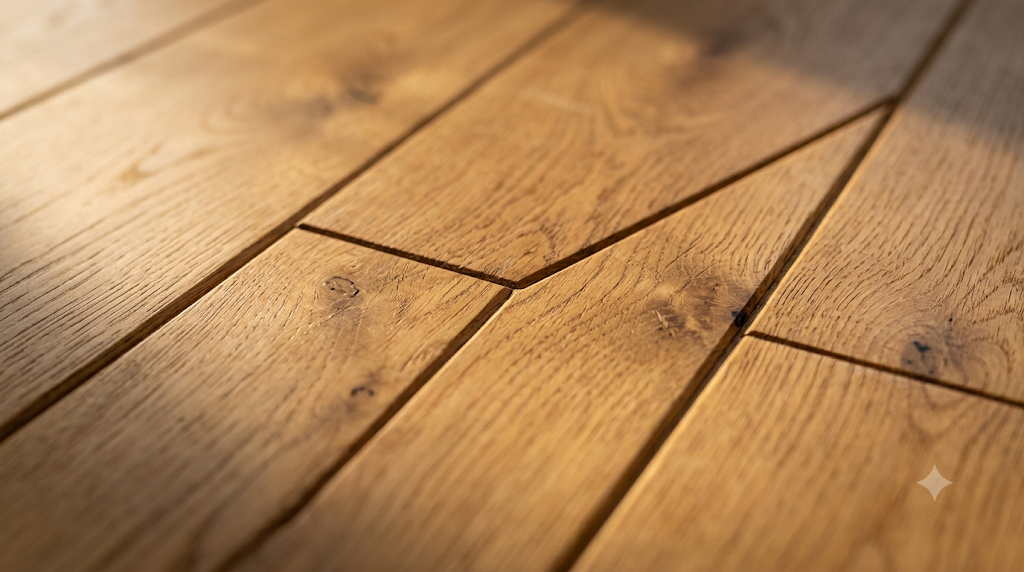
Both look like real wood, because both are real wood. So when you are choosing between engineered and solid wood flooring, the question is not “which is better?” It is “which is right for this room, this home, and this budget?”
Get that decision right and the floor rewards you for decades. Get it wrong and you fight the wood the whole time. Here is how the two compare, and how to pick.
What is the actual difference?
Solid wood is exactly what it sounds like: a single piece of timber, milled into a board, right through. Oak, walnut, ash… whatever the species, it is solid all the way down.
Engineered wood is a real hardwood layer on top, bonded to several layers of ply or timber underneath, built up in a cross-grain. The top you see and walk on is genuine wood. The clever bit is the construction beneath it.
That difference in build is what drives everything else… how each one handles moisture, heat, and time.
At a glance
| Feature | Engineered wood | Solid wood |
|---|---|---|
| Construction | Real hardwood layer over ply core | Solid timber throughout |
| Stability with heat & moisture | Excellent… resists movement | Moves more with humidity |
| Underfloor heating | Well suited | Often not recommended |
| Re-sanding | A few times (depends on wear layer) | Many times over its life |
| Typical lifespan | 20 – 40+ years | 50 – 100+ years |
| Material cost | Lower to mid | Mid to high |
| Best for | Kitchens, extensions, UFH, wider boards | Living rooms, bedrooms, heritage homes |
Where engineered wins
Engineered wood is the more stable of the two. The cross-layered core means it barely reacts to changes in temperature and humidity, so it stays put where solid wood might gap, cup, or bow.
That makes it the sensible choice for:
- Underfloor heating. The construction copes with the heat cycles that solid wood struggles with.
- Kitchens, extensions, and rooms with more moisture in the air.
- Wide boards. You can go wider without the movement risk you would face in solid.
It is also often better value for the look, which is why many homeowners land here.
Where solid wins
Solid wood is the long game. Because it is timber all the way through, it can be sanded back and refinished many more times than engineered… so it can be brought back to life again and again over a lifetime.
It comes into its own in:
- Bedrooms and living rooms, where moisture and heat are stable.
- Period and heritage homes, where a solid timber floor simply belongs.
- Homes where you want a floor that outlives the mortgage and can be refinished for the next generation.
The trade-off is that solid wood needs a stable environment. Put it over underfloor heating or in a damp room and you are asking for trouble.
So which should you choose?
Work through it room by room, not house by house.
- Do you have underfloor heating? Engineered, almost always.
- Is it a kitchen, extension, or anywhere humidity swings? Engineered.
- Is it a bedroom, lounge, or period room with stable conditions? Solid is a beautiful, lasting choice.
- Do you want the longest possible life with repeated refinishing? Solid.
- Do you want the real-wood look for a bit less, with fewer restrictions on where it goes? Engineered.
Plenty of homes use both… engineered downstairs over heating, solid in the bedrooms. There is no rule that says the whole house must match.
A note on quality
The “engineered vs solid” question matters less than the quality of what you actually buy. A well-made engineered board with a thick wear layer will outlast a cheap, thin one many times over. A solid floor is only as good as the fitting and the subfloor beneath it.
Whichever way you lean, buy the best board you can and have it fitted properly. That is what decides how the floor looks in twenty years.
How is engineered wood flooring laid?
Engineered boards are laid one of two ways: glued directly to the subfloor, or floated over an underlay with the boards clicking or locking together. Glue-down gives the most solid feel underfoot and is the usual choice over underfloor heating. Floating is quicker and suits sound, level subfloors.
Whichever method fits your home, the sequence is the same. The subfloor is levelled and moisture-tested, the boards acclimatise on site for a few days, and an expansion gap is left around the perimeter so the floor can move with the seasons. Skip any of those steps and even the best board will fail early.
If you would rather leave it to the professionals, our wood floor installation team fits engineered and solid floors across Yorkshire and the rest of the UK.
Still not sure?
The honest answer is that the right floor depends on your rooms, your heating, and how long you want it to last. That is a conversation worth having before you buy anything.
Our flooring design service walks you through it… comparing engineered and solid against your actual home, so you choose once and get it right. Get in touch and we will help you decide.
